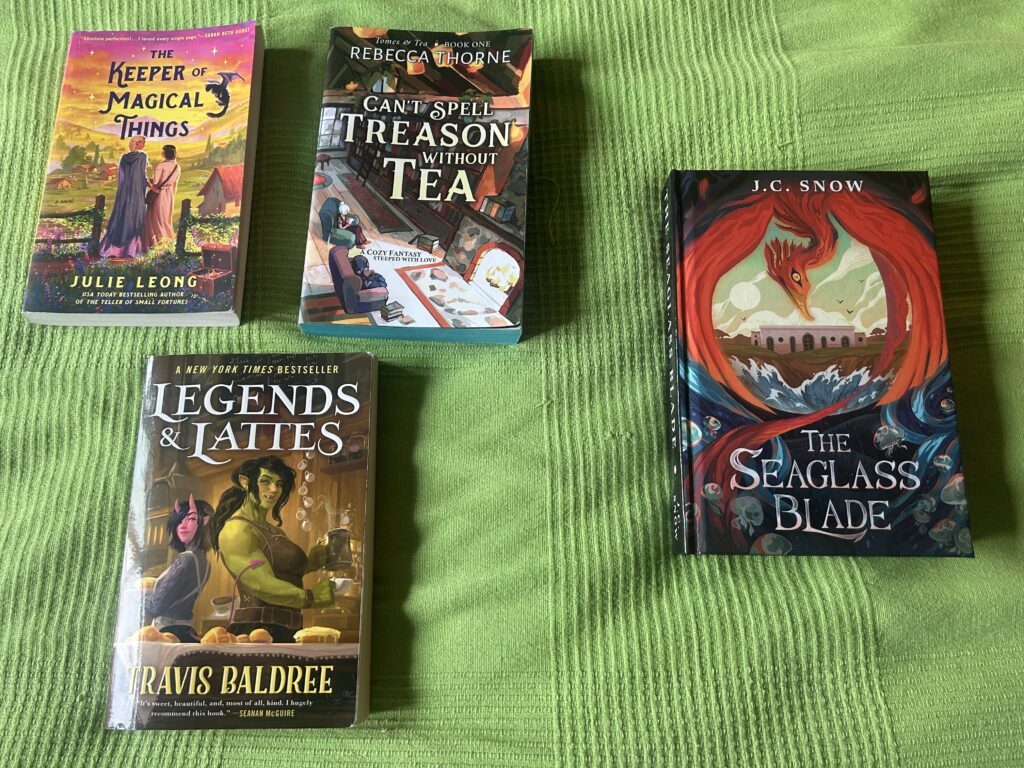
which of these is not cozy?
I don’t usually read reviews of my books; I approach reviews like a dog that has heard the word “bath.” But The Seaglass Blade spent a month posted on Netgalley for advanced reviews, and said reviews have started coming in, and the whole point of Netgalley is for the publisher (who is also me) to see the advanced reviews and think about what this means for the book’s publication and marketing. I receive an email containing every review posted to Netgalley, and I am prepared to remind myself softly, “All reader experiences are valid” while I cry myself to sleep.
Luckily, I do not have to cry myself to sleep (so far)! The majority of the reviews have been fantastic. Some readers have created long and detailed reviews about why they love the book, and that is such an incredible feeling; I’m really grateful to everyone who has downloaded the book and given it a chance. But here’s a genuine surprise…
Multiple reviewers described The Seaglass Blade as “cozy.”
Now you have to understand: I was afraid that people would go into Seaglass thinking “cozy” because found family is central to the story (even if said found family is haunted by tragedy, loss, and betrayal). I was afraid that they would happily pick the book up and be forever traumatized, because, as another early reader and friend said when I mentioned the reviews, “What the [bleeep], that book is NOT cozy.” The content warning list is neither short nor welcoming, the stakes are world-level, and there’s a ton of grief and death. But the same readers who loved the book and talked about it as cozy also talked about these things! Which made me think…
I HAVE NO IDEA WHAT COZY MEANS.
And so the time has come: I WILL READ COZY BOOKS. I will find out what is this thing called cozy!
I had read exactly one cozy book to this point: Julie Leong’s The Keeper of Magical Things. I read this one because I went to the book launch (I love hearing authors talk about their writing), and I was intrigued about how Leong described cozy as a subgenre, and what she loved about it.
She characterized cozy as aimed towards the goal of readers feeling good and hopeful at the end of the story. Personal stakes rather than world stakes are central; the world is good and generally does not need saving by the characters, even if a little tweaking around the edges might be required. There is a guaranteed happy ending, and people helping one another is going to be part of how that ending happens. Certain kinds of events are not going to happen in a cozy fantasy, or are happening in the past or very far from the center of the story (such as wars and sexual assault). Love stories might be important but generally will not be sexually explicit. People are at heart basically good, and want to be good to one another.
I do want people to finish my books feeling hopeful (sort of? I also want them to sit at the kitchen table staring into space, thinking what just happened? which was me after Gideon and Harrow). I also tend to see people as basically good, which is probably why I have a hard time writing villains. So I thought I’ll give this cozy thing a try, and I did!
And I definitely see the appeal. While reading Keeper of Magical Things, and the other two cozy books I read for this experiment, I kept wanting to come back to it. The world itself was a welcoming place, and the characters were interesting and sweet (also some excellent sapphic yearning, and catdragons!). I wanted to spend time with it each day, as a little bit of healing from all of my own much messier life experiences.
I then moved on to Can’t Spell Treason without Tea, by Rebecca Thorne. I had already read (and loved) Thorne’s This Gilded Abyss, which is definitely not cozy, but offers enemies-to-lovers lesbians on a submersible haunted by a mysterious and deadly force (recommend). I already had two copies of Treason for various reasons, so I dived in!
Treason has a magical lesbian and a sword lesbian living the life of my dreams, so I have to admit I mostly spent this book being jealous. They opened a coffee and bookshop (do you know how often my wife and I have talked about doing this? cries in needing health insurance and providing for a child) in a small town where they are immediately welcomed and make friends and their business flourishes. I want this life! Also they have a healthy and thoughtful communication style which made me feel that I am very immature.
But despite my increased awareness of my personal shortcomings, the same thing happened: I wanted to come back to this book. It was something comforting for every day, and it was also comforting to know that there was a whole series to look forward to, about these characters and their bookshop and their griffins and the people of this world that they would meet. Adventures would continue, and they would continue to be a safe and welcoming place.
Finally (for this literary exploration), I read the OG, Legends and Lattes by Travis Baldree. I immediately could see why so many people love this book, because the main character and the world were so interesting, and each of the side characters were well-crafted and unique, including the love interest. And the theme of people helping one another here is the real center of the book, the magic that the main character wielded. (The descriptions of food were also genuinely mouthwatering.) The characters went against “type” (I think in a D&D sense), where the more negative aspects of who they “should” have been were watered down or refused by the characters: the orc doesn’t want to fight, the succubus doesn’t want to influence or tempt people. I suspect this might also be part of what cozy offers.
So…did I write a cozy book without realizing it?
Talking about this with some other author friends, one thing that came up is that books primarily centered around relationships, regardless of the level of stakes or violence, have very few ways to describe them in terms of SFF subgenre. There’s only cozy and romantasy. Everything with a love story gets associated with romantasy, even when the book really doesn’t fit romance parameters. I wonder if a book that is centered around found family and their relationships, which Seaglass certainly is, might also have the association with cozy, especially when it’s combined with the underlying premise that people are generally good and want to help one another.
Generally, though, I’d say Seaglass is not cozy in the way these true cozy books are, because of the level of stakes, the level of on-page violence, and the themes of loss and grief. It might be that while cozy is about creating and living in a safe and lovely place, Seaglass is about defending such a place. That said, at an early stage in writing Seaglass I thought of it as “cozydark,” because in a world that is violent and where innocent people suffer (like grimdark), still people love one another and create beauty (like cozy). I was told that cozydark is Not A Thing, but I think it is.
So for marketing purposes: The Seaglass Blade is a queer cozydark fantasy, currently available for preorder!
Do you know any other queer cozydark books? Or how else would you describe a book with cozy and also more intense elements?